
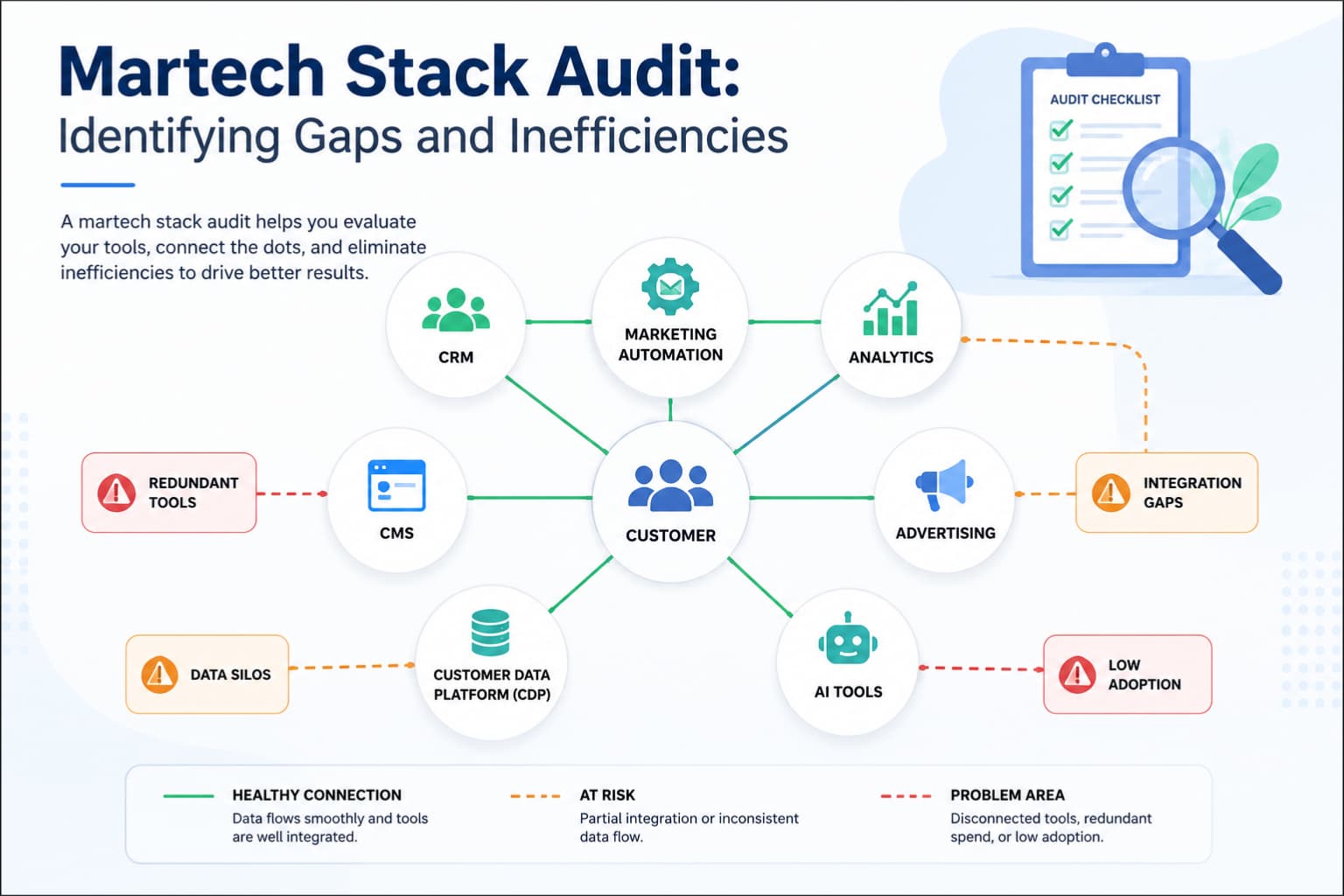
Marketing teams have never had more technology at their disposal. From CRM systems and marketing automation platforms to analytics tools and AI-powered solutions, modern organizations rely on a growing ecosystem of technologies to execute campaigns and improve customer experiences.
According to the 2025 Martech Landscape Report, businesses can now choose from more than 15,000 marketing technology solutions worldwide. While this abundance of options creates new opportunities, it also makes managing technology investments far more challenging. Research shows that 62.1% of marketers are using more martech tools today than they were two years ago, driven largely by rapid AI adoption.
More tools, however, do not always lead to better outcomes. Many organizations struggle with overlapping functionality, disconnected data, low platform adoption, and rising software costs. A martech stack audit helps identify these inefficiencies, optimize technology investments, and ensure every platform supports broader business objectives.
What Is a Martech Stack Audit?
A martech stack audit is a structured evaluation of the marketing technologies used across an organization. It assesses whether existing tools are delivering value, supporting business objectives, and helping teams operate efficiently.
As martech ecosystems become more complex, regular audits have become increasingly important. A comprehensive audit goes beyond creating a software inventory to evaluate tool usage, adoption, integrations, and overall effectiveness. Recent research found that 65.7% of marketing professionals identify data integration as one of the biggest challenges affecting their martech stack, highlighting the difficulties organizations face when managing disconnected systems and fragmented data.
A martech stack audit helps answer critical questions such as:
- Which tools are actively driving results?
- Where do redundant capabilities exist?
- Are integrations enabling seamless data flow?
- Which platforms are underutilized or unused?
- What capabilities are missing from the current stack?
- How effectively is marketing technology supporting business goals?
The insights gained from a martech stack audit can help organizations reduce unnecessary technology spend, improve operational efficiency, and build a more connected marketing ecosystem. Rather than focusing solely on software, an effective audit evaluates the people, processes, and technologies that influence marketing performance.
Why Martech Stack Audits Matter More Than Ever

Marketing technology has evolved from a supporting function into a critical driver of growth, customer experience, and operational efficiency. Yet as martech ecosystems expand, many organizations lose visibility into how their tools are actually being used and whether those investments are generating measurable business value.
A martech stack audit helps organizations move beyond assumptions and evaluate the real effectiveness of their technology ecosystem. The need for regular audits has become increasingly important for several reasons.
1. Martech Investments Are Growing Faster Than Utilization
Organizations continue to add new platforms, subscriptions, and AI-powered applications to support evolving marketing strategies. However, technology adoption often fails to keep pace with investment. Many teams use only a fraction of the capabilities available within their existing tools, leaving significant value untapped.
Regular audits help identify underutilized platforms, unused licenses, and overlooked features that can improve performance without requiring additional software purchases.
2. Technology Costs Are Under Greater Scrutiny
Marketing leaders are facing increasing pressure to justify software spending and demonstrate clear returns on technology investments. As martech budgets grow, executives expect greater transparency into how each platform contributes to pipeline growth, customer acquisition, retention, and revenue.
A martech audit provides the visibility needed to evaluate platform performance, eliminate unnecessary costs, and prioritize investments that deliver measurable business outcomes.
3. Disconnected Systems Create Hidden Operational Costs
Many organizations operate with data spread across multiple platforms, making it difficult to maintain a consistent view of customers, campaigns, and performance. Integration gaps often lead to manual reporting, duplicated work, and inconsistent metrics across teams.
Auditing the martech stack helps identify breakdowns in data flow and reveals opportunities to improve connectivity, automation, and reporting accuracy.
4. AI Adoption Is Accelerating Technology Complexity
The rapid adoption of AI-powered marketing tools has created new opportunities for automation, personalization, content creation, and analytics. At the same time, many organizations are introducing AI solutions without fully evaluating how they fit within their existing technology ecosystem.
A martech audit helps ensure that new AI investments complement current capabilities rather than creating redundant workflows, fragmented processes, or additional data silos.
5. Technology Sprawl Reduces Efficiency
Over time, marketing teams often acquire tools to solve immediate challenges without assessing whether existing platforms already provide similar functionality. This gradual expansion can create overlapping capabilities, fragmented workflows, and unnecessary software costs.
Regular audits help organizations simplify their technology ecosystem, reduce complexity, and improve operational efficiency across teams.
6. Business Priorities Continuously Evolve
The technology stack that supported business objectives two or three years ago may no longer align with current growth strategies, customer expectations, or organizational goals. As markets change, technology investments must evolve alongside them.
Conducting regular audits ensures that every platform continues to serve a strategic purpose and supports the organization's long-term objectives.
Signs Your Martech Stack Needs an Audit
Martech inefficiencies rarely appear overnight. In most organizations, they develop gradually as new tools are added, teams adopt different workflows, and business requirements evolve. Over time, these issues can increase costs, reduce productivity, and limit the value generated from marketing technology investments.
While every organization's technology ecosystem is unique, several common warning signs indicate it may be time to conduct a martech stack audit.
| Warning Sign | What It May Indicate | Potential Business Impact |
| Rising software costs without improved performance | Unused licenses, redundant platforms, or underutilized features | Lower ROI and unnecessary technology spend |
| Multiple tools performing similar functions | Overlapping capabilities and lack of platform governance | Increased costs and fragmented workflows |
| Inconsistent reporting across teams | Data silos, integration issues, or inconsistent data definitions | Reduced confidence in reporting and slower decision-making |
| Heavy reliance on manual processes | Limited automation and disconnected systems | Reduced productivity and increased operational risk |
| Low user adoption rates | Poor onboarding, insufficient training, or usability challenges | Underutilized investments and lower platform value |
| Difficulty tracking customer journeys | Fragmented customer data and weak system integration | Incomplete customer insights and ineffective personalization |
| Frequent requests for new software | Existing tools may be overlooked or misaligned with current needs | Technology sprawl and rising complexity |
| Slow campaign execution | Workflow bottlenecks and inefficient processes | Delayed time-to-market and reduced agility |
Looking Beyond Individual Symptoms
Organizations often focus on individual issues such as reporting challenges, low adoption, or increasing software costs. However, these symptoms are frequently connected. For example, poor system integration can lead to manual reporting processes, inconsistent data, lower user confidence, and slower campaign execution.
A martech stack audit helps identify the root causes behind these challenges rather than simply addressing the symptoms. A comprehensive assessment of technology usage, integrations, governance, and business alignment can reveal opportunities to streamline operations and improve overall marketing performance.
When Should You Conduct an Audit?
While there is no universal schedule, many organizations benefit from conducting a martech stack audit annually or whenever significant changes occur, such as:
- Major technology investments or platform migrations
- Rapid growth through expansion or acquisitions
- Significant changes in marketing strategy
- Increased adoption of AI-powered tools
- Persistent reporting or data quality issues
- Budget reduction initiatives
The earlier inefficiencies are identified, the easier it becomes to optimize technology investments and prevent small issues from evolving into larger operational challenges.
How to Conduct a Martech Stack Audit: A 5-Step Framework
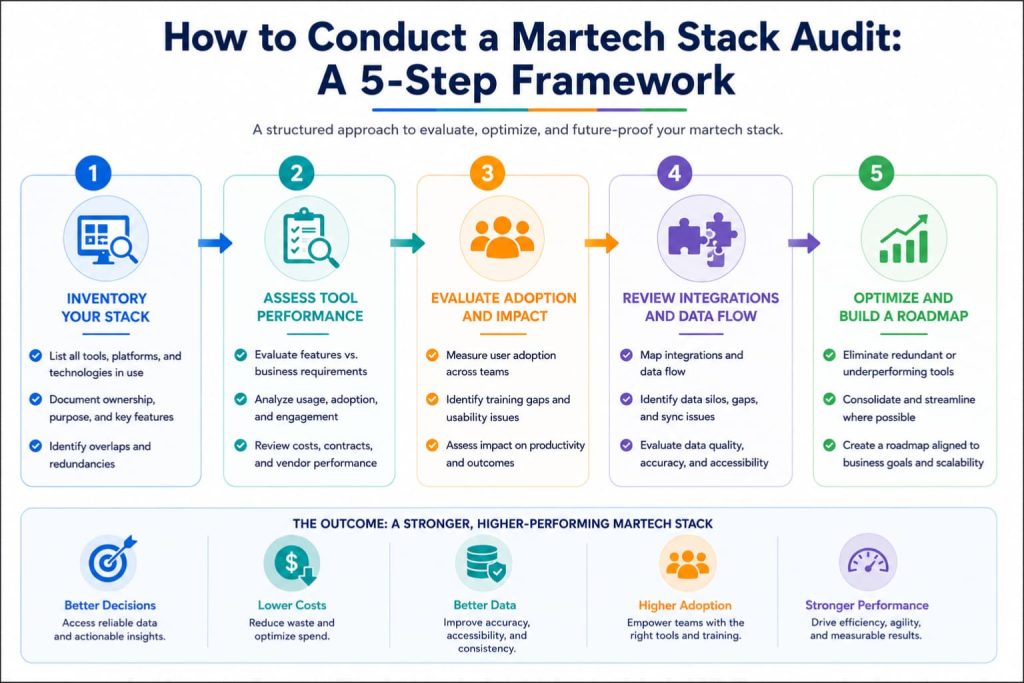
A successful martech stack audit requires more than simply reviewing a list of tools. The objective is to understand how effectively your technology ecosystem supports business goals, enables collaboration, improves customer experiences, and generates measurable returns.
The following five-step framework can help organizations identify inefficiencies, eliminate redundancies, and build a more connected and scalable marketing technology environment.
Step 1: Create a Complete Martech Inventory
Start by documenting every marketing technology used across the organization. Include details such as the tool's purpose, owner, annual cost, renewal date, and primary users. This creates a clear view of the existing technology ecosystem and often reveals tools that operate outside centralized oversight.
Step 2: Assess Tool Functionality and Overlap
Categorize tools by function, such as CRM, marketing automation, analytics, content management, or AI. Then evaluate whether multiple platforms perform similar tasks. Identifying overlapping capabilities can uncover opportunities to reduce complexity and optimize technology spending.
Step 3: Evaluate Usage and Adoption
Analyze how frequently each platform is used and whether teams are leveraging its key features. Low adoption rates or limited feature utilization may indicate training gaps, usability challenges, or misalignment with business needs.
Step 4: Review Integrations and Data Flow
Examine how information moves between systems and identify any integration gaps that affect reporting, automation, or customer experiences. A well-connected martech stack should enable consistent data sharing across platforms without excessive manual intervention.
Step 5: Identify Optimization Opportunities
Use audit findings to determine which tools should be retained, consolidated, replaced, or retired. The objective is to create a streamlined technology ecosystem that improves efficiency, reduces unnecessary costs, and aligns with long-term business goals.
The Long-Term Impact of a Martech Stack Audit
A martech stack audit delivers benefits that extend far beyond cost reduction and technology optimization. By providing a clear understanding of how tools, data, and processes work together, audits help organizations build a more efficient and scalable marketing operation.
A well-audited martech ecosystem improves visibility across the customer journey, strengthens data quality, and enables more accurate performance measurement. With better-connected systems and more reliable insights, marketing teams can make faster decisions, improve campaign execution, and respond more effectively to changing business needs.
Regular audits also support long-term technology governance. As new platforms emerge and business priorities evolve, organizations can make more informed technology decisions, avoid unnecessary complexity, and ensure future investments align with strategic objectives.
Ultimately, a martech stack audit helps create a technology foundation that supports sustainable growth, operational efficiency, and better customer experiences.
Key Metrics to Evaluate During a Martech Stack Audit

A successful martech stack audit should be supported by measurable data rather than assumptions. Tracking key performance indicators helps organizations understand whether their technology investments are delivering value, supporting user adoption, and improving operational efficiency.
- Technology Adoption Rate– Measure how actively teams use each platform and whether adoption extends beyond a small group of power users. Low adoption rates may indicate training challenges, usability issues, or a mismatch between the tool and business requirements.
- Feature Utilization– Many organizations use only a fraction of the capabilities available within their martech platforms. Evaluating feature usage can reveal opportunities to improve efficiency and maximize the value of existing technology investments.
- Integration Performance– Assess how effectively data moves between systems. Metrics such as synchronization reliability, data accuracy, and reporting consistency can help identify integration gaps that impact decision-making and campaign execution.
- Technology Costs– Review software licensing fees, subscriptions, implementation costs, and ongoing maintenance expenses. Understanding the total cost of ownership provides a clearer picture of whether each platform delivers sufficient value.
- Return on Investment (ROI)– Evaluate how individual tools contribute to key business outcomes such as lead generation, customer acquisition, campaign performance, and revenue growth. This helps distinguish high-value platforms from those that may no longer justify their cost.
Consistent monitoring of these metrics provides a clearer understanding of martech stack performance and highlights opportunities for optimization, consolidation, and more informed technology investment decisions.
Building a More Effective Martech Ecosystem
As martech ecosystems continue to expand, maintaining visibility into technology performance, usage, and value becomes increasingly important. Without regular evaluation, organizations risk accumulating redundant tools, fragmented data, and unnecessary costs that limit marketing effectiveness.
A martech stack audit provides a structured way to assess technology investments, uncover inefficiencies, and identify opportunities for optimization. It helps organizations ensure that every platform contributes to operational efficiency, supports strategic objectives, and delivers measurable business value.
Organizations that audit their martech stack regularly are better equipped to adapt to evolving business needs, make informed technology decisions, and build a more connected, scalable marketing ecosystem for long-term success.