
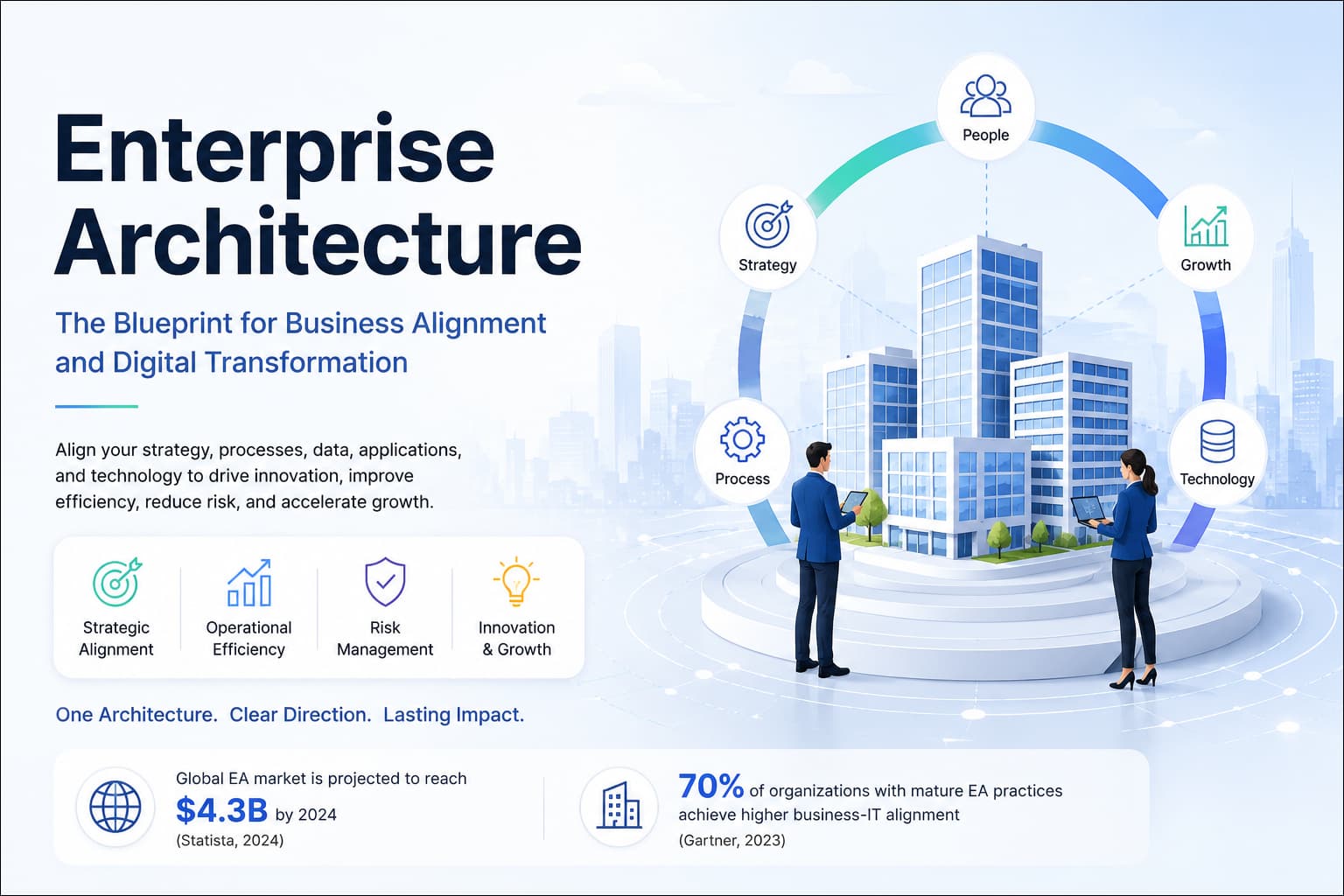
Businesses continue to invest heavily in AI, cloud computing, automation, and data-driven initiatives. Despite these investments, many organizations still face disconnected systems, duplicate processes, inconsistent data, and rising technology costs.
The problem often isn't the technology itself. Lack of alignment between business goals and technology decisions creates complexity that grows over time.
Global IT spending is projected to surpass $6.31 trillion in 2026, reflecting the scale of digital investments across industries. Yet technology alone doesn't guarantee results. Organizations need a clear framework that connects strategy, operations, data, applications, and infrastructure.
Enterprise architecture provides that framework.
It gives business and technology leaders a complete view of how the organization operates, where inefficiencies exist, and what changes are needed to support future growth. Strong enterprise architecture helps reduce complexity, improve decision-making, and ensure technology investments contribute to measurable business outcomes.
Companies that establish a clear architectural foundation are often better positioned to scale operations, support innovation, and execute digital transformation initiatives with greater confidence.
What Is Enterprise Architecture?
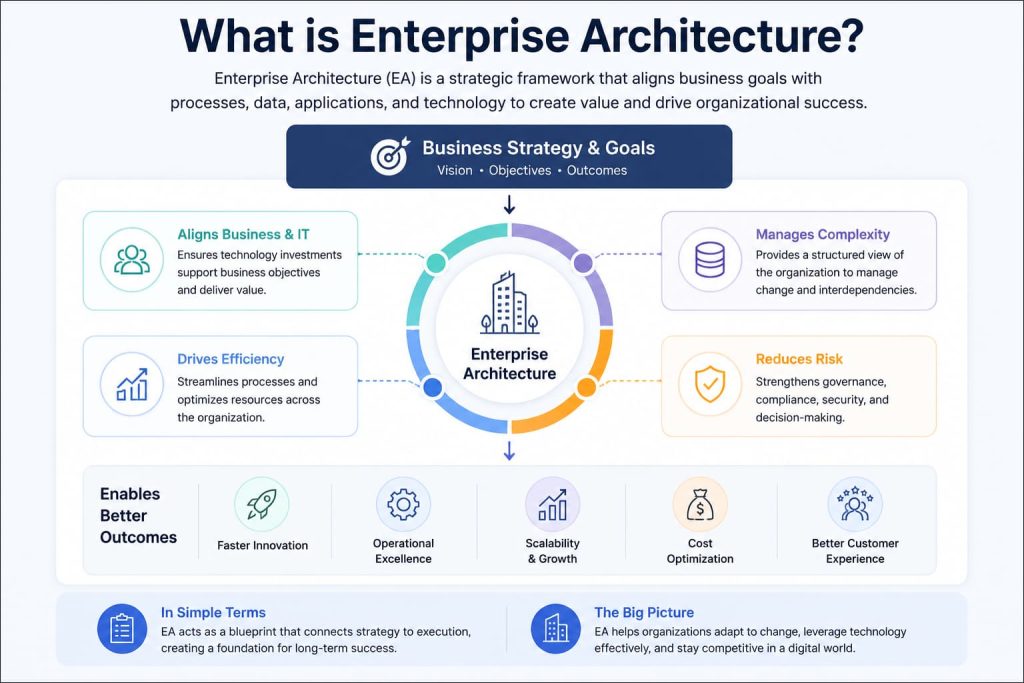
Enterprise architecture (EA) is a strategic framework that connects an organization's business objectives with its processes, data, applications, and technology infrastructure. It provides a structured approach for understanding how different parts of the business work together and how technology can support long-term goals.
Think of enterprise architecture as the blueprint of an organization. Just as architects design buildings to ensure every component works together efficiently, enterprise architects design and manage the relationships between business operations and technology systems.
Without a defined architecture, organizations often end up with fragmented systems, duplicate applications, inconsistent data, and technology investments that deliver limited value. Enterprise architecture addresses these challenges by creating a clear roadmap for technology adoption, modernization, and business growth.
A typical enterprise architecture strategy focuses on four core areas:
- Business Architecture – Business capabilities, processes, governance, and strategic objectives.
- Data Architecture – How data is collected, stored, managed, secured, and shared across the organization.
- Application Architecture – The software systems and applications that support business operations.
- Technology Architecture – Infrastructure, cloud platforms, networks, security, and supporting technologies.
Rather than focusing solely on IT, enterprise architecture helps organizations make informed decisions about investments, resource allocation, risk management, and digital transformation. The result is a technology environment that supports business priorities instead of operating separately from them.
Why Enterprise Architecture Matters More Than Ever
Organizations today manage a growing mix of cloud platforms, AI tools, legacy systems, business applications, and data sources. Without a structured approach, technology complexity can quickly turn into operational inefficiencies, higher costs, and slower decision-making.
Enterprise architecture helps create alignment between business objectives and technology investments, giving organizations a clearer path toward growth and modernization.
| Business Challenge | How Enterprise Architecture Helps |
| Disconnected systems and data silos | Improves integration and information flow across the organization |
| Duplicate applications | Reduces unnecessary technology spending and maintenance costs |
| Slow decision-making | Provides visibility into processes, systems, and dependencies |
| Digital transformation complexity | Creates a roadmap for modernization initiatives |
| Security and compliance concerns | Strengthens governance and risk management |
| Scaling operations | Builds a technology foundation that supports growth |
Enterprise architecture is no longer limited to managing IT infrastructure. It enables organizations to make smarter investment decisions, reduce complexity, and build a technology ecosystem that supports long-term business goals.
The Four Core Components of Enterprise Architecture
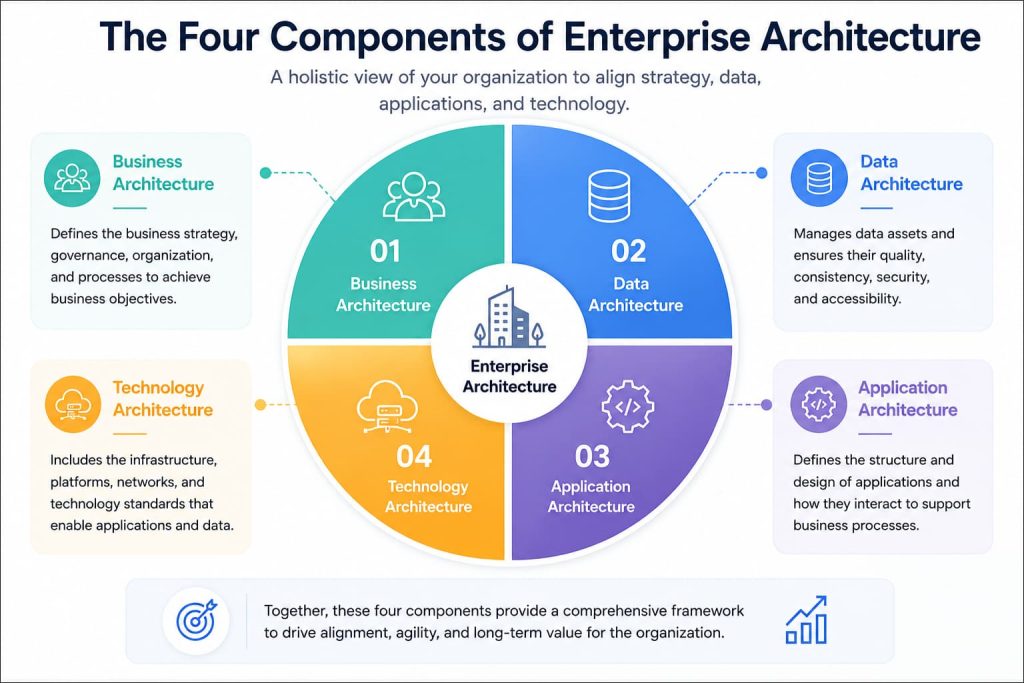
Enterprise architecture is built on four interconnected components. Together, they provide a complete view of how an organization operates and how technology supports business objectives.
1. Business Architecture
Business architecture focuses on the organization's strategy, capabilities, processes, and governance structure. It defines how the business creates value and ensures technology initiatives support broader organizational goals.
Key areas include:
- Business strategy and objectives
- Business capabilities
- Operating models
- Organizational structure
- Governance frameworks
2. Data Architecture
Data architecture defines how information is collected, stored, managed, integrated, and accessed across the organization. It helps maintain data quality, consistency, and security while supporting analytics and decision-making.
Key areas include:
- Data governance
- Data management
- Data integration
- Data quality standards
- Analytics and reporting
3. Application Architecture
Application architecture focuses on the software systems that support business operations. It ensures applications work together efficiently, minimizes duplication, and improves interoperability across the technology ecosystem.
Key areas include:
- Enterprise applications
- Software integration
- APIs and services
- Application lifecycle management
- User experience and functionality
4. Technology Architecture
Technology architecture provides the infrastructure that supports applications, data, and business processes. It includes the hardware, networks, cloud environments, and security controls required to keep operations running smoothly.
Key areas include:
- Cloud platforms
- Networks and infrastructure
- Cybersecurity
- Hardware and servers
- Technology standards
Each component plays a unique role, but the real value of enterprise architecture comes from the way these elements work together. A gap in one area can affect the entire organization, making alignment across all four components essential for long-term success.
Key Benefits of Enterprise Architecture
Enterprise architecture helps organizations move beyond short-term technology decisions and build a foundation that supports long-term business goals. Here are six benefits that make it a valuable investment.
1. Better Alignment Between Business and IT
Many organizations struggle when business teams and IT departments operate with different priorities. Enterprise architecture creates a shared roadmap that connects technology investments to business objectives.
Example: A retail company planning to expand its e-commerce operations can use enterprise architecture to ensure its technology upgrades directly support customer acquisition and revenue growth goals.
2. Reduced Technology Costs
Over time, businesses often accumulate multiple tools that perform similar functions. Enterprise architecture helps identify redundancies and optimize technology spending.
Example: A company using separate CRM systems across different departments can consolidate platforms, reducing licensing, maintenance, and training costs.
3. Faster Digital Transformation
Large transformation projects often fail because systems, processes, and teams are not aligned. Enterprise architecture provides a clear implementation framework that reduces delays and confusion.
Example: A bank migrating to the cloud can use enterprise architecture to prioritize workloads, manage dependencies, and minimize operational disruptions during the transition.
4. Improved Decision-Making
Enterprise architecture provides visibility into how systems, processes, and data interact across the organization. This enables leaders to make decisions based on accurate information rather than assumptions.
Example: A manufacturing company can quickly assess how introducing a new ERP system will impact production, inventory management, and supply chain operations.
5. Stronger Risk and Compliance Management
A structured architecture makes it easier to identify security gaps, compliance issues, and operational risks before they affect the business.
Example: A healthcare provider handling sensitive patient information can establish governance standards that support regulatory compliance and strengthen data security.
6. Greater Scalability for Future Growth
Growth often introduces new markets, products, customers, and technologies. Enterprise architecture helps organizations expand without creating unnecessary complexity.
Example: A SaaS company entering international markets can build a scalable technology environment that supports increased users, regional regulations, and additional business functions without requiring a complete system overhaul.
When organizations have a clear architectural foundation, growth becomes easier to manage, technology investments deliver greater value, and strategic initiatives can move forward with fewer obstacles.
Popular Enterprise Architecture Frameworks
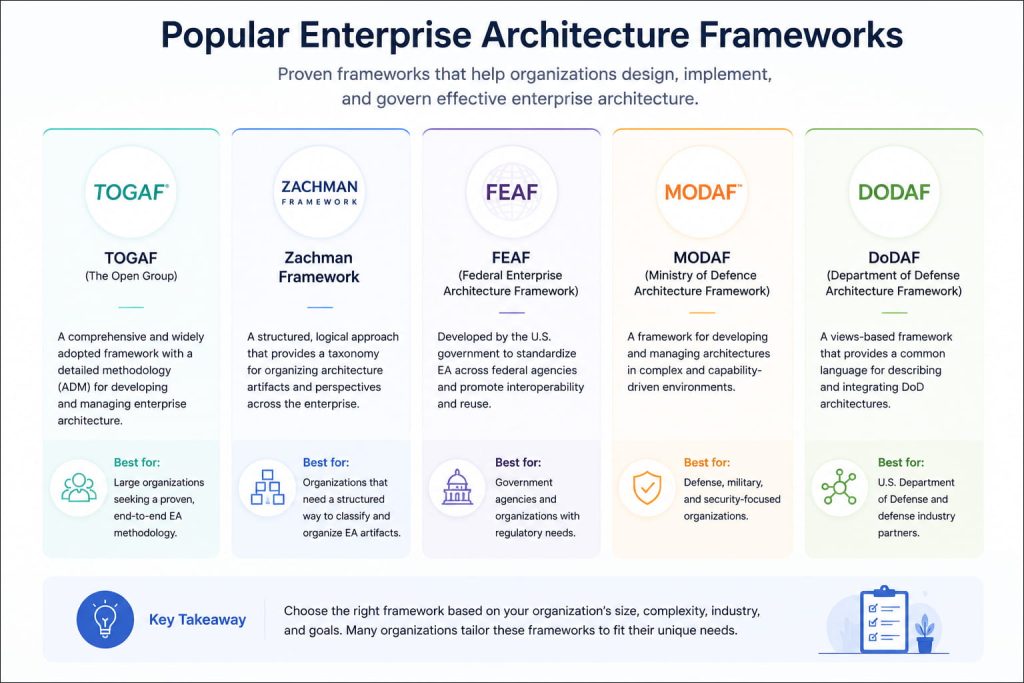
Enterprise architecture provides the direction, but frameworks provide the structure. They offer proven methodologies, best practices, and governance models that help organizations design, manage, and evolve their architecture more effectively.
While dozens of frameworks exist, a few have become industry standards.
TOGAF (The Open Group Architecture Framework)
TOGAF is one of the most widely adopted enterprise architecture frameworks in the world. It provides a step-by-step approach for planning, designing, implementing, and governing enterprise architecture.
Organizations often choose TOGAF because of its flexibility and comprehensive Architecture Development Method (ADM), which helps teams create a clear roadmap from current-state architecture to future-state goals.
Zachman Framework
The Zachman Framework focuses on organizing and categorizing architectural information. Rather than prescribing a process, it provides a structured way to view an organization from different perspectives, including business leaders, architects, developers, and end users.
It is particularly useful for large enterprises dealing with complex systems and operations.
FEAF (Federal Enterprise Architecture Framework)
Developed for U.S. federal agencies, FEAF promotes standardization, interoperability, and efficient resource management across large organizations.
Many public-sector organizations use FEAF principles to improve governance and align technology investments with organizational objectives.
Gartner Enterprise Architecture Framework
Gartner's approach places greater emphasis on business outcomes than rigid architectural processes. The framework encourages organizations to focus on strategy, innovation, and measurable business value while maintaining architectural discipline.
This approach is often favored by organizations operating in fast-changing business environments.
Which Framework Is Right for Your Organization?
There is no universal framework that fits every business. The right choice depends on factors such as organizational size, industry requirements, technology maturity, and strategic goals.
Many enterprises combine elements from multiple frameworks rather than following a single methodology. The objective is not strict adherence to a framework but creating an architecture practice that supports business growth, operational efficiency, and long-term technology planning.
Enterprise Architecture and Digital Transformation
Digital transformation is no longer limited to adopting new technologies. Success depends on how well those technologies integrate with existing systems, processes, and business goals. Without a clear strategy, organizations often end up with disconnected initiatives that create more complexity than value.
Enterprise architecture provides the foundation for successful transformation by aligning technology investments with business objectives. It gives organizations a clear view of their current environment and helps identify the changes needed to support future growth.
Common transformation initiatives supported by enterprise architecture include:
- Cloud migration and modernization
- AI and automation adoption
- Legacy system modernization
- Data and analytics programs
- Cybersecurity improvements
- Customer experience initiatives
For example, a company implementing AI-powered customer support must connect customer data, business applications, security controls, and workflows. Enterprise architecture helps manage these dependencies, reducing implementation risks and improving project outcomes.
Organizations with a strong architectural foundation are better positioned to execute transformation initiatives, scale new technologies, and generate greater value from their investments.
Common Challenges in Enterprise Architecture
Building an effective enterprise architecture is not without its challenges. While the goal is to create alignment across the organization, many businesses must first untangle years of accumulated complexity. Legacy systems, disconnected applications, and inconsistent processes can make architectural changes difficult to implement, particularly in large enterprises.
People can be just as challenging as technology. New governance frameworks, standardized processes, and system changes often require teams to work differently than they have in the past. Without strong leadership support and clear communication, even well-planned architecture initiatives can struggle to gain organization-wide adoption.
Another challenge lies in keeping pace with change. Business priorities evolve, new technologies enter the market, and customer expectations continue to shift. Enterprise architecture cannot remain static. Organizations that see the greatest results treat architecture as an ongoing practice, one that adapts alongside the business while maintaining a clear direction for future growth.
Future Trends Shaping Enterprise Architecture
Enterprise architecture continues to evolve as organizations adopt new technologies and operating models. Several trends are expected to influence how enterprises design and manage their architecture in the years ahead.
- AI-Powered Architecture – AI tools are helping architects analyze systems, identify dependencies, and accelerate decision-making.
- Composable Architectures – Organizations are moving toward modular systems that can be updated or replaced without disrupting the entire technology ecosystem.
- Cloud-Native Strategies – Cloud-first approaches continue to drive demand for scalable, flexible, and resilient architectures.
- Data-Centric Decision Making – Stronger focus on data governance and accessibility is helping businesses unlock greater value from their information assets.
- Cybersecurity-Driven Design – Security is becoming a core architectural consideration rather than an afterthought.
- Sustainable IT Practices – Organizations are increasingly considering energy efficiency and environmental impact when planning technology investments.
These trends highlight a broader shift in the role of enterprise architecture. Rather than focusing solely on technology governance, enterprise architecture is becoming a strategic function that helps organizations adapt, innovate, and grow with greater confidence.
Building a Strong Foundation for the Future
Technology investments deliver the greatest value when they support clear business objectives. Enterprise architecture provides the structure needed to align strategy, processes, data, applications, and infrastructure across the organization.
Organizations that lack a well-defined architectural framework often struggle with disconnected systems, inefficient workflows, and technology decisions that create long-term complexity. Enterprise architecture helps address these challenges by providing a clear direction for technology planning and business growth.
From cloud migration and AI adoption to application modernization and business expansion, enterprise architecture enables organizations to make smarter decisions and adapt to changing business needs. Companies that invest in a strong architectural foundation today will be better positioned to innovate, scale operations, and remain competitive in the years ahead.
Turn Your Enterprise Architecture Strategy Into Action
Enterprise architecture is not just about managing technology, it's about creating a roadmap for sustainable business growth.
Whether you're modernizing legacy systems, planning a cloud migration, implementing AI solutions, or driving a digital transformation initiative, a well-defined architecture can help you reduce risk, improve efficiency, and maximize the value of your technology investments.
Looking for expert guidance? Connect with our team to assess your current architecture, identify opportunities for improvement, and build a future-ready technology strategy tailored to your business goals.