
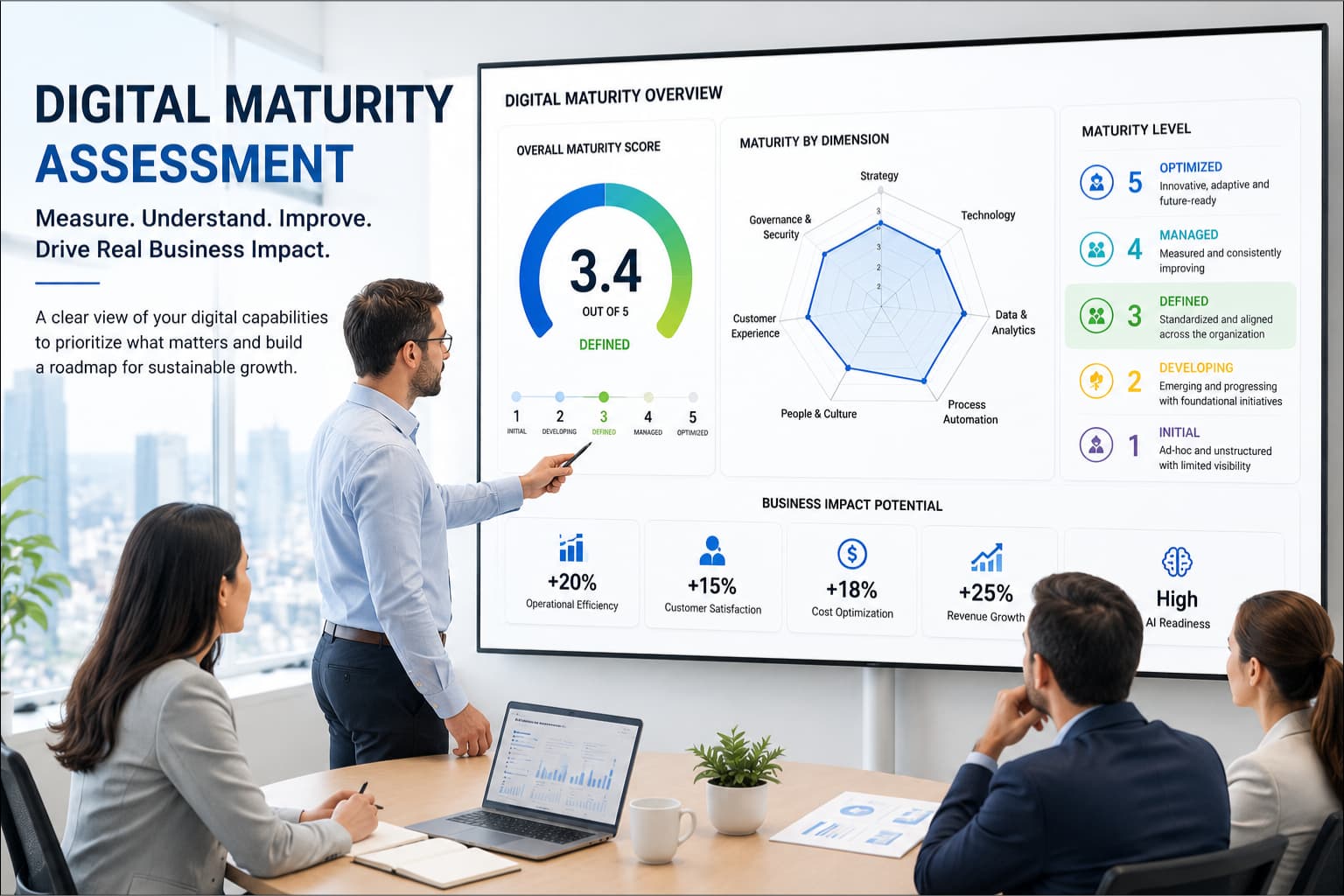
Organizations continue to invest heavily in digital initiatives, from cloud migration and automation to artificial intelligence and advanced analytics. Global spending on digital transformation is projected to reach $3.4 trillion by 2026, highlighting the growing focus on technology-driven growth and innovation.
Yet a critical question remains: Are these investments delivering the expected business value?
Technology adoption alone does not guarantee better customer experiences, faster decision-making, or stronger operational performance. Two organizations can invest in similar technologies and achieve very different outcomes. One may unlock measurable business value, while the other struggles with siloed data, inefficient processes, and slow transformation progress.
Research from McKinsey underscores this challenge. Their studies found that only 16% of organizations successfully improved performance and sustained those gains through digital transformation initiatives. The difference often comes down to digital maturity rather than technology itself.
This is where a Digital Maturity Assessment plays a vital role. It helps organizations evaluate how effectively they use technology, data, processes, and people to achieve business goals. More importantly, it uncovers capability gaps, highlights improvement opportunities, and provides a clear roadmap for transformation success.
With AI becoming a strategic priority across industries, understanding digital maturity has never been more important. Organizations with strong digital foundations are better positioned to drive innovation, improve agility, and maximize returns on their technology investments.
What is Digital Maturity Assessment?
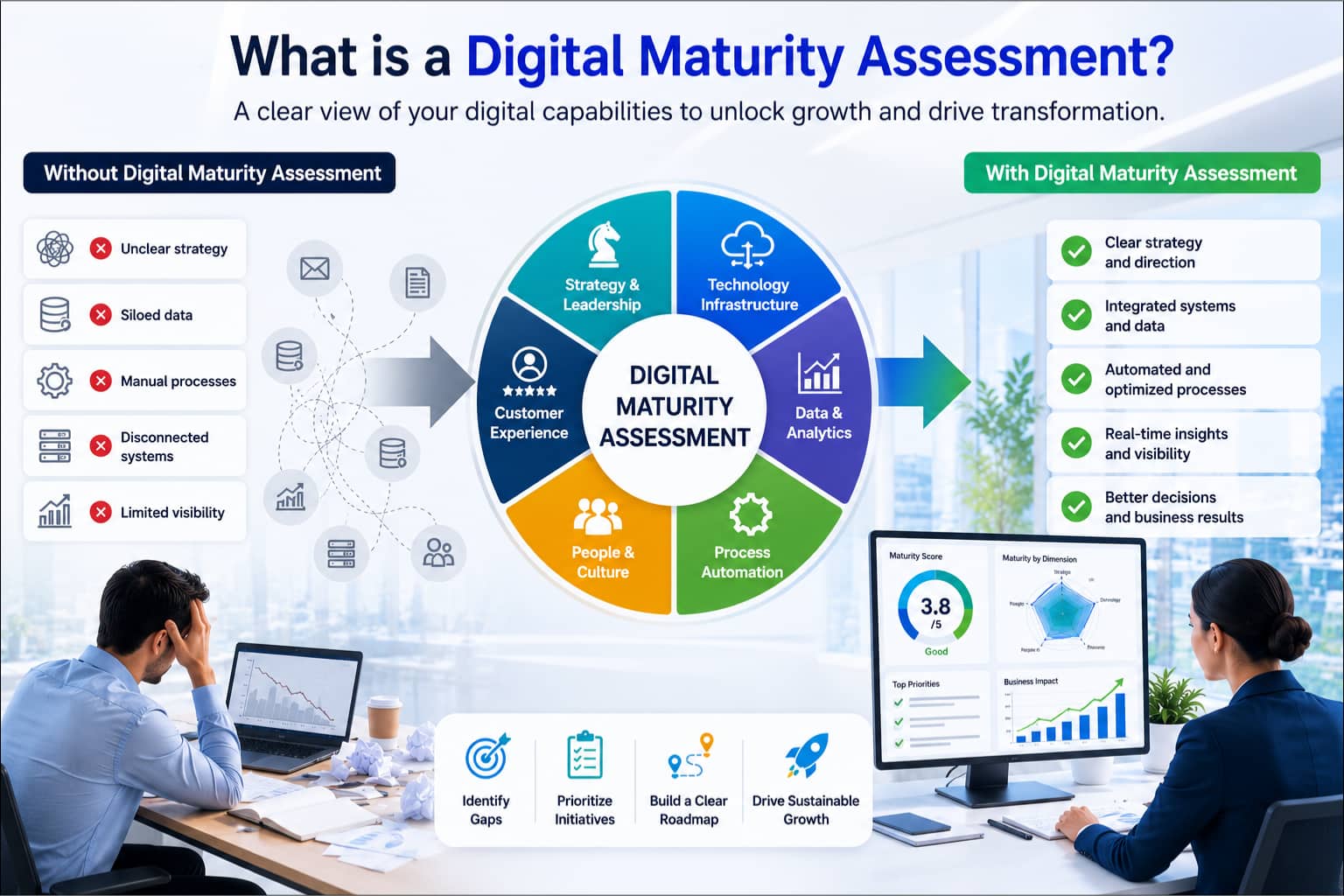
A Digital Maturity Assessment is a framework used to evaluate how well an organization uses technology, data, processes, and people to achieve business goals. It goes beyond measuring technology adoption and examines whether digital initiatives are creating measurable business value.
Think of it as a reality check for your digital transformation efforts. An organization may invest in AI, automation, cloud platforms, and analytics tools, but those investments do not automatically lead to better business outcomes. A maturity assessment helps determine whether technology investments are supported by the right strategy, governance, skills, and operating model.
Most assessments evaluate key areas such as:
- Digital strategy and leadership
- Customer experience
- Data and analytics
- Technology infrastructure
- Process automation
- Workforce readiness and culture
- Governance, risk, and cybersecurity
The results provide a clear view of an organization's current digital capabilities and highlight areas that need attention. These insights help business leaders prioritize investments, address capability gaps, and create a roadmap for long-term transformation success.
More importantly, a digital maturity assessment helps organizations focus on what matters most. It provides the clarity needed to make smarter investment decisions, align teams around common goals, and build a stronger foundation for future digital initiatives.
Why Digital Maturity Matters
Many organizations invest in digital technologies expecting faster growth, better customer experiences, and improved efficiency. Yet technology alone does not guarantee these outcomes. The difference often comes down to digital maturity, how well an organization integrates technology, data, processes, and people to support business goals.
Despite global digital transformation spending projected to reach $3.4 trillion by 2026, many organizations still struggle to generate consistent value from their digital investments. A lack of digital maturity can lead to fragmented systems, inefficient workflows, and missed opportunities.
The table below highlights the difference:
| Low Digital Maturity | High Digital Maturity |
| Siloed data across departments | Connected data that supports decision-making |
| Manual and repetitive processes | Automated workflows that improve efficiency |
| Reactive decision-making | Data-driven planning and forecasting |
| Inconsistent customer experiences | Personalized and seamless customer journeys |
| Technology investments with unclear ROI | Technology investments aligned with business goals |
| Limited AI adoption and scalability | Strong foundation for AI and innovation |
Organizations with higher digital maturity are not necessarily spending more on technology. They are making better use of the technology, data, and capabilities they already have. This is why a Digital Maturity Assessment is often the first step toward achieving meaningful and sustainable transformation outcomes.
The Five Levels of Digital Maturity
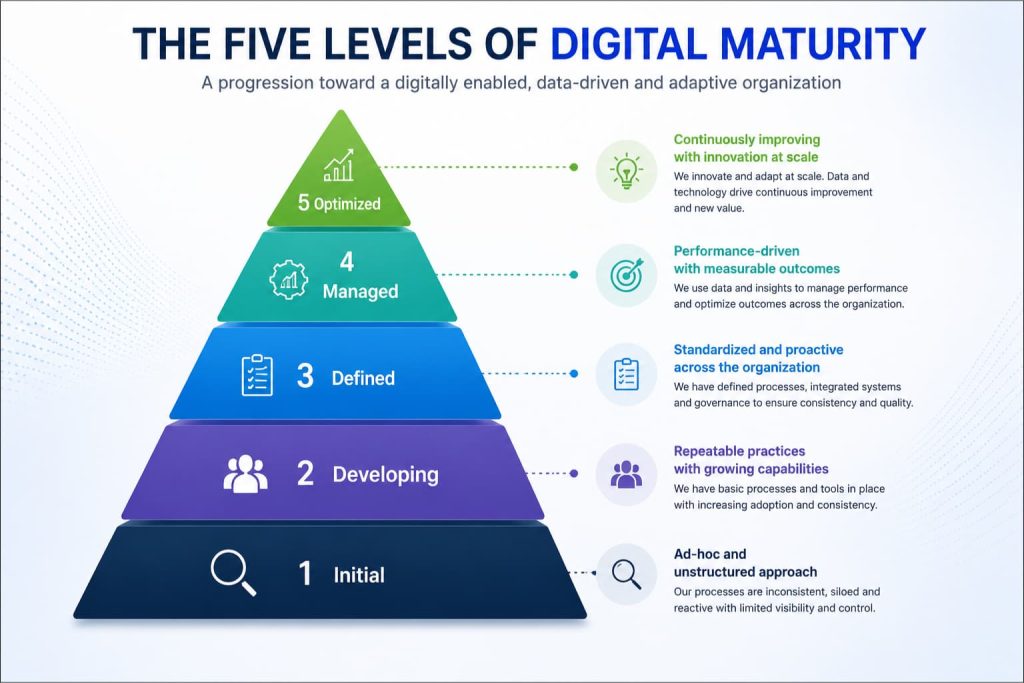
Digital maturity is not a fixed destination. Organizations progress through different stages as their digital capabilities grow. Understanding these levels can help leaders identify where their organization stands today and what steps are needed to move forward.
Level 1: Initial
Digital efforts are largely reactive and disconnected. Many processes remain manual, data is scattered across systems, and technology investments are made to solve immediate challenges rather than support a long-term strategy.
What this looks like: Teams rely heavily on spreadsheets, reports are generated manually, and employees spend significant time searching for information across multiple systems.
Level 2: Developing
Organizations begin investing in digital tools and establishing formal digital initiatives. While progress is visible, many departments still operate independently, limiting the full value of these investments.
What this looks like: The sales team uses a CRM, finance has adopted automation software, and operations has implemented cloud-based tools, but these systems rarely share data with one another.
Level 3: Defined
Digital transformation becomes a business priority rather than an isolated IT initiative. Processes are standardized, collaboration improves across teams, and data starts playing a larger role in decision-making.
What this looks like: Leadership teams have access to centralized dashboards, departments follow consistent processes, and digital initiatives are aligned with broader business goals.
Level 4: Managed
Organizations measure and optimize digital performance using defined metrics. Automation, analytics, and governance frameworks are embedded across key business functions, leading to greater efficiency and consistency.
What this looks like: Customer service workflows are automated, performance metrics are tracked in real time, and business decisions are supported by data rather than assumptions.
Level 5: Optimized
Digital capabilities are deeply integrated into the organization. Teams continuously improve processes, adopt new technologies with confidence, and use data to drive innovation, growth, and customer value.
What this looks like: AI supports decision-making, customer experiences are highly personalized, and teams can quickly adapt to changing business priorities without major operational disruptions.
No organization reaches the highest level overnight. Digital maturity is a continuous journey, and understanding your current stage is the first step toward building a successful transformation roadmap.
What Does a Digital Maturity Assessment Measure?
A Digital Maturity Assessment provides a holistic view of an organization's digital capabilities. Rather than focusing solely on technology adoption, it evaluates the key factors that influence transformation success.
This broader perspective helps organizations understand whether their technology investments, business processes, workforce capabilities, and strategic priorities are working together to support long-term growth and innovation.
While assessment frameworks may vary, most evaluate the following areas:
| Dimension | What It Assess |
| Strategy & Leadership | Whether digital initiatives align with business goals and have executive support |
| Customer Experience | How well the organization meets customer expectations across digital channels |
| Data Analytics | The quality, accessibility, and use of data for decision-making |
| Technology Infrastructure | The organization's technology foundation, integration capabilities, and scalability |
| Process Automation | Opportunities to reduce manual work and improve operational efficiency |
| People & Culture | Workforce readiness, digital skills, and openness to change |
| Governance & Security | Policies, compliance, risk management, and cybersecurity practices |
These dimensions are closely connected. Strength in one area cannot fully compensate for weaknesses in another. For example, advanced technologies may deliver limited value if employees lack the skills to use them, while high-quality data may go underutilized without clear processes and leadership support.
This is why a comprehensive assessment examines the organization as a whole rather than individual departments or technology investments in isolation. The insights gained help leaders identify strengths, uncover hidden gaps, and focus on the areas that will have the greatest impact on transformation outcomes.
Benefits of Conducting a Digital Maturity Assessment
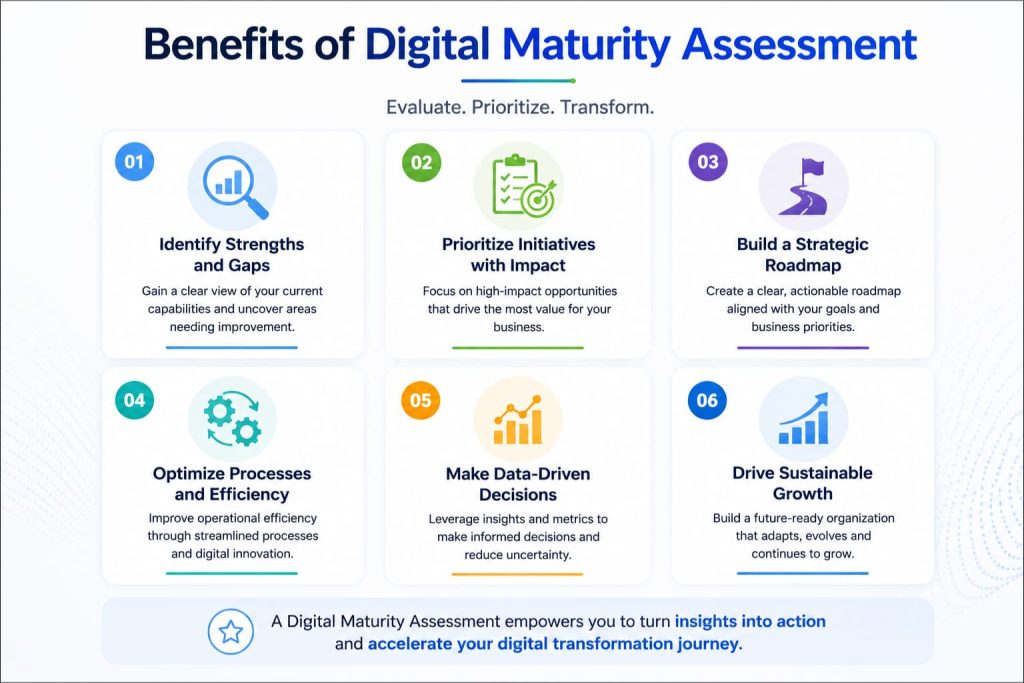
A Digital Maturity Assessment does more than measure current capabilities. It provides organizations with a clear understanding of where they stand, what challenges may be holding them back, and which opportunities deserve immediate attention. The insights gained can help leaders make informed decisions and create a stronger foundation for long-term growth.
1. Greater Visibility Into Digital Capabilities
Many organizations invest in digital initiatives without having a complete picture of their current capabilities. A maturity assessment provides an objective view of strengths, weaknesses, and areas that require improvement. This visibility helps leaders understand what is working, what is not, and where future efforts should be focused.
2. Smarter Investment Decisions
Technology investments can quickly become expensive when there is no clear direction. A maturity assessment helps organizations identify the initiatives that are most likely to support business goals, reducing the risk of investing in tools or projects that deliver limited value.
3. Improved Operational Efficiency
Manual processes, duplicated work, and disconnected systems often create unnecessary delays and costs. A maturity assessment highlights inefficiencies across the organization, helping teams identify opportunities to streamline workflows, improve productivity, and make better use of available resources.
4. Better Alignment Between Business and Technology
Digital transformation efforts are most successful when technology supports broader business objectives. A maturity assessment helps bridge the gap between business priorities and technology initiatives, ensuring teams are working toward shared goals rather than pursuing isolated projects.
5. Stronger Readiness for AI and Emerging Technologies
Many organizations are exploring AI, automation, and advanced analytics, but these technologies depend on strong foundations. Data quality, governance, skills, and process maturity all play an important role. A maturity assessment helps determine whether the organization is prepared to scale these initiatives successfully.
6. A Clear Roadmap for Transformation
One of the most valuable outcomes of a maturity assessment is a clear path forward. Rather than relying on assumptions or guesswork, organizations gain practical recommendations that help prioritize initiatives, address capability gaps, and guide future transformation efforts.
Organizations that regularly assess their digital maturity are often better positioned to respond to change, improve customer experiences, and generate greater value from their technology investments. In a business environment where digital capabilities continue to influence competitiveness, understanding your current state is often the first step toward meaningful progress.
Signs Your Organization Needs a Digital Maturity Assessment
A Digital Maturity Assessment is designed to provide a clear picture of an organization's current digital capabilities and identify the areas that require attention. While methodologies vary, most assessments seek answers to a common set of questions.
Assessment Checklist
☐ Is there a clear digital strategy aligned with business goals?
☐ Do leadership teams have access to timely and reliable data for decision-making?
☐ Are customer experiences consistent across channels?
☐ Can existing technology systems share information efficiently?
☐ Which processes still rely heavily on manual effort?
☐ Does the workforce have the skills needed to support digital initiatives?
☐ Are governance, compliance, and cybersecurity practices well established?
☐ Is the organization prepared to scale AI and automation initiatives?
☐ Are technology investments delivering measurable business value?
☐ What capability gaps are limiting transformation progress?
The answers help organizations move beyond assumptions and gain an objective view of their digital readiness. More importantly, they provide a foundation for prioritizing initiatives, addressing weaknesses, and building a roadmap that supports long-term business goals.
Digital Maturity and AI: Why Strong Foundations Matter
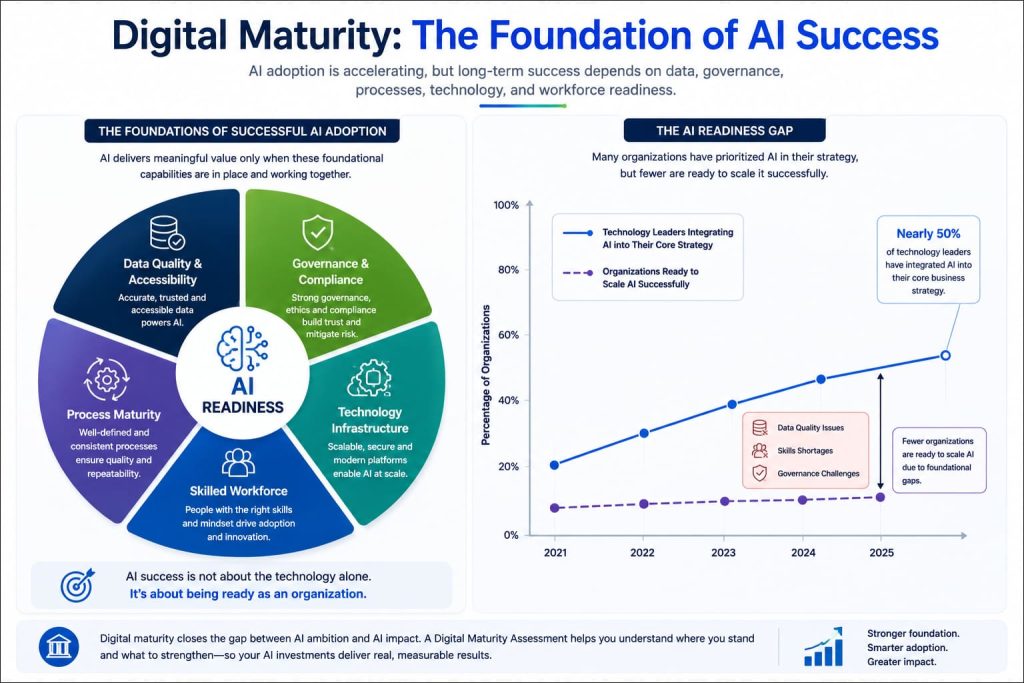
Artificial intelligence has quickly moved from experimentation to boardroom discussions. Organizations across industries are exploring AI to improve productivity, enhance customer experiences, automate routine tasks, and uncover new growth opportunities.
However, successful AI adoption depends on much more than selecting the right tools. AI systems rely on quality data, well-defined processes, strong governance, and a workforce that understands how to use the technology effectively. Without these foundations, even the most advanced AI initiatives can struggle to deliver meaningful results.
This challenge is already visible across the market. According to PwC, nearly half of technology leaders say AI is now integrated into their core business strategy. Yet many organizations continue to face obstacles related to data quality, skills shortages, and governance concerns.
Digital maturity helps address these challenges. Organizations with stronger digital capabilities are typically better prepared to scale AI initiatives because they already have the structures needed to support adoption. Their data is more accessible, processes are more consistent, and decision-making is supported by clear governance frameworks.
In many ways, AI has made digital maturity even more important. Before organizations can fully capitalize on emerging technologies, they need a solid foundation. A Digital Maturity Assessment helps determine whether that foundation is already in place, or where improvements are needed before larger investments are made.
Making Digital Transformation Count
Organizations are investing heavily in digital initiatives, yet many still struggle to connect those investments to measurable business results. According to McKinsey, only 16% of digital transformations successfully improve performance and sustain those gains over time. This gap highlights an important reality: technology alone does not drive transformation success.
A Digital Maturity Assessment helps organizations understand what is working, where challenges exist, and which areas deserve immediate attention. Rather than relying on assumptions, leaders gain a clearer picture of their current capabilities and the steps needed to achieve their business objectives.
The organizations that achieve the strongest outcomes are not always those spending the most on technology. They are the ones making informed decisions, aligning investments with business priorities, and building the right foundation for future growth. A Digital Maturity Assessment provides the clarity needed to turn digital ambitions into meaningful business results.
Ready to Assess Your Digital Maturity?
Whether your organization is exploring AI, modernizing legacy systems, improving customer experiences, or accelerating digital transformation, understanding your current level of maturity is the first step toward meaningful progress.
A Digital Maturity Assessment can help you:
✓ Identify capability gaps before they become barriers to growth
✓ Prioritize technology investments with confidence
✓ Strengthen readiness for AI and automation initiatives
✓ Improve operational efficiency and decision-making
✓ Build a practical roadmap for long-term transformation success
The question is not whether digital transformation should be a priority. The real question is whether your organization is ready to maximize its impact.
Get started with a Digital Maturity Assessment and gain the clarity needed to make smarter decisions, reduce risk, and create lasting business value.