
Introduction
Marketing teams have access to more data than ever before, yet many still struggle to answer one critical question:
Which marketing efforts are actually driving revenue?
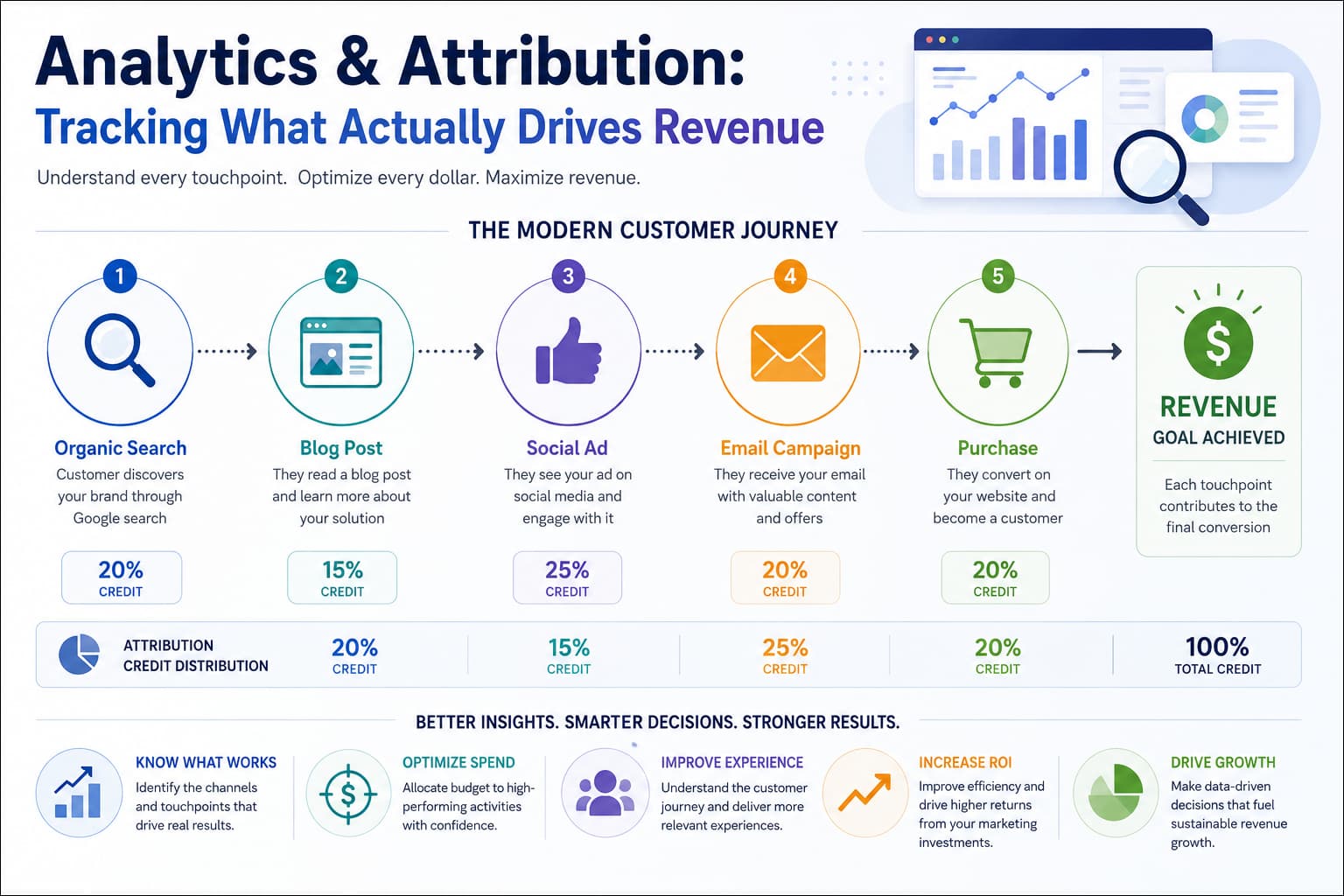
A customer might discover your brand through search, read a blog post, engage with a social media ad, subscribe to your email list, and later make a purchase. With so many touchpoints involved, understanding what influenced the conversion isn't always straightforward.
This is where analytics and attribution become essential. Analytics helps you understand how users interact with your campaigns and website, while attribution identifies which channels and touchpoints contribute to conversions and revenue.
Together, they provide the insights needed to make smarter budget decisions, improve marketing performance, and focus on the activities that drive business growth.
In this guide, we'll explore how analytics and attribution work, the most effective attribution models, the metrics that matter most, and practical strategies for improving revenue outcomes.
What Is Marketing Analytics?
Marketing analytics is the process of collecting, measuring, and analyzing data to evaluate the effectiveness of your marketing efforts. It helps businesses understand how customers interact with campaigns, content, and digital channels, and how those interactions contribute to business goals.
Rather than focusing solely on metrics like impressions, clicks, or website visits, modern marketing analytics connects marketing activities to meaningful outcomes such as:
- Leads generated
- Conversion rates
- Customer acquisition
- Customer lifetime value
- Revenue growth
For example, a campaign that generates thousands of visitors may appear successful, but if those visitors don't convert into customers, its business impact is limited. Conversely, a campaign with lower traffic but higher conversion rates may deliver significantly greater value.
Marketing analytics transforms raw data into actionable insights. Businesses can identify what's working, uncover opportunities for improvement, and invest more confidently in the strategies that drive growth.
What Is Attribution?
Analytics shows what happened. Attribution helps explain why it happened and which marketing efforts influenced the outcome.
Attribution is the process of assigning credit to the channels and touchpoints that contribute to a conversion, lead, or sale. Its purpose is to help marketers understand how different interactions influence customer decisions throughout the buying journey.
Most customers don't convert after a single interaction. A typical journey may include multiple touchpoints, such as:
- Organic search
- Blog content
- Social media ads
- Email campaigns
- Direct website visits
This creates an important question: Which touchpoint deserves credit for the conversion?
Attribution helps answer that question by revealing how channels work together to drive results. Without a clear attribution strategy, businesses often overvalue the final interaction and underestimate the impact of awareness and nurturing efforts that occur earlier in the customer journey.
A well-defined attribution model provides a more complete view of marketing performance and supports smarter budget and investment decisions.
Why Analytics and Attribution Matter for Revenue Growth
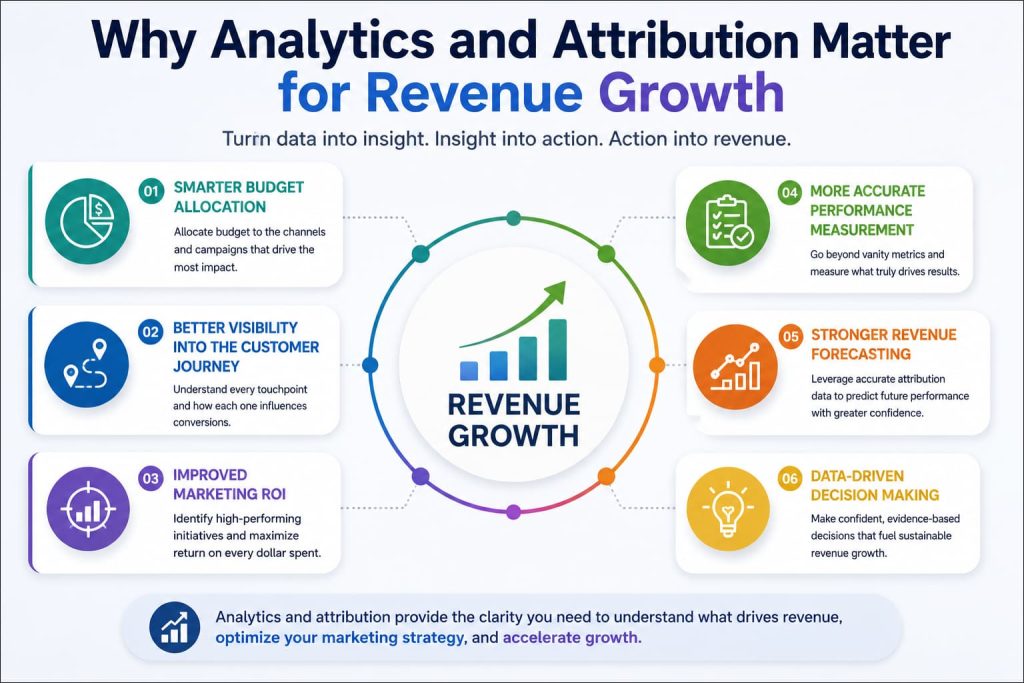
Tracking clicks, impressions, and website traffic can provide useful insights into campaign performance, but those metrics don't always reveal what's driving revenue. Analytics and attribution help businesses move beyond surface-level reporting and understand how marketing efforts contribute to real business outcomes.
1. Smarter Budget Allocation
Marketing budgets are often distributed across multiple channels, campaigns, and platforms. Analytics and attribution help identify which efforts generate the most valuable leads, conversions, and revenue, allowing teams to invest more confidently in the initiatives that deliver measurable results.
2. Better Visibility into the Customer Journey
Customers rarely convert after a single interaction. They may discover a brand through search, engage with content, interact with social media ads, and return through email before making a purchase. Attribution helps uncover these paths and reveals the touchpoints that influence buying decisions.
3. Improved Marketing ROI
Understanding which channels contribute most to revenue enables businesses to reduce spending on underperforming campaigns and focus resources on strategies that generate stronger returns. This leads to more efficient marketing investments and improved overall performance.
4. More Accurate Performance Measurement
Analytics provides visibility into campaign performance across channels, audiences, and stages of the funnel. This broader perspective helps teams evaluate marketing effectiveness more accurately and understand how individual efforts contribute to business goals.
5. Stronger Revenue Forecasting
Historical performance data can reveal trends and patterns that support more reliable forecasting. Marketing and business leaders can use these insights to set realistic growth targets, plan future investments, and make more informed strategic decisions.
6. Data-Driven Decision Making
Reliable analytics replaces assumptions with evidence. Marketing teams can make decisions based on customer behavior, campaign performance, and revenue contribution rather than relying on intuition alone. This creates a stronger foundation for long-term growth and optimization.
Organizations that invest in analytics and attribution gain a clearer understanding of what drives results, where marketing dollars have the greatest impact, and how to support sustainable revenue growth.
Understanding Attribution Models
Not every customer follows the same path to purchase. Some convert after a single interaction, while others engage with multiple channels before making a decision. Attribution models help determine how credit is assigned to each touchpoint in the customer journey.
The attribution model you choose can significantly influence how marketing performance is measured. A channel that appears highly effective under one model may receive less credit under another, making it important to select a model that aligns with your business goals and customer behavior.
| Attribution Model | How Credit Is Assigned | Best For | Limitation |
| First-Touch Attribution | 100% credit goes to the first interaction with the brand. | Measuring brand awareness and identifying channels that attract new audiences. | Ignores all touchpoints that occur later in the customer journey. |
| Last-Touch Attribution | 100% credit goes to the final interaction before conversion. | Short sales cycles and simple reporting. | Overlooks the role of awareness and nurturing channels. |
| Linear Attribution | Credit is distributed equally across all touchpoints. | Understanding the contribution of every channel in the journey. | Assumes every interaction has the same influence on conversion. |
| Time-Decay Attribution | More credit is assigned to touchpoints closer to the conversion. | Businesses with longer sales cycles and multiple interactions. | Can undervalue early-stage awareness efforts. |
| Data-Driven Attribution | Machine learning analyzes customer behavior and assigns credit based on actual contribution. | Complex customer journeys and revenue-focused reporting. | Requires sufficient data and can be more difficult to interpret. |
Example Customer Journey
Imagine a customer follows this path before making a purchase:
Organic Search → Blog Post → Social Media Ad → Email Campaign → Purchase
Under each attribution model, the credit would be assigned differently:
- First-Touch Attribution: Organic Search receives 100% credit.
- Last-Touch Attribution: Email Campaign receives 100% credit.
- Linear Attribution: Each touchpoint receives 25% credit.
- Time-Decay Attribution: Email Campaign receives the highest share of credit, while Organic Search receives the least.
- Data-Driven Attribution: Credit is distributed based on the actual influence of each touchpoint on the conversion.
Which Attribution Model Is Best?
There is no universal attribution model that works for every business. The right approach depends on factors such as your sales cycle, marketing channels, customer behavior, and reporting objectives.
Organizations with shorter sales cycles may find simple models sufficient, while businesses with longer and more complex customer journeys often benefit from data-driven attribution. A more comprehensive model can provide greater visibility into how channels work together to generate leads, conversions, and revenue.
The goal is not to find a perfect attribution model. The goal is to gain a clearer understanding of which marketing efforts influence business outcomes and use those insights to make better decisions.
Key Revenue-Focused Analytics Metrics
Collecting data is only valuable when you're tracking the right metrics. Many marketers spend too much time monitoring clicks, impressions, and traffic numbers without understanding how those metrics impact revenue.
A revenue-focused analytics strategy prioritizes metrics that connect marketing performance to business outcomes.
Revenue Attribution
Revenue attribution measures how much revenue can be linked to specific channels, campaigns, or marketing activities.
This metric helps answer questions such as:
- Which channel generates the most revenue?
- Which campaigns contribute the highest value customers?
- Where should marketing budgets be increased?
Return on Marketing Investment (ROMI)
ROMI measures the revenue generated for every dollar spent on marketing.
Formula:
(Revenue Generated − Marketing Cost) ÷ Marketing Cost × 100
A higher ROMI indicates that marketing investments are delivering stronger returns.
Customer Acquisition Cost (CAC)
CAC measures the cost of acquiring a new customer.
Formula:
Total Marketing and Sales Costs ÷ Number of New Customers Acquired
Tracking CAC helps businesses evaluate whether customer acquisition efforts are cost-effective and sustainable.
Customer Lifetime Value (CLV)
CLV estimates the total revenue a customer is expected to generate throughout their relationship with a business.
Customers with a high lifetime value often justify higher acquisition costs, making CLV an important metric for long-term growth.
Conversion Rate
Conversion rate measures the percentage of users who complete a desired action, such as making a purchase, filling out a form, or requesting a demo.
Even small improvements in conversion rates can have a significant impact on revenue without increasing marketing spend.
Marketing Efficiency Ratio (MER)
MER evaluates overall marketing performance by comparing total revenue to total advertising spend.
Formula:
Total Revenue ÷ Total Ad Spend
This metric provides a high-level view of how efficiently marketing investments are generating revenue.
Assisted Conversions
Not every channel closes the sale, but many play an important role in influencing it. Assisted conversions measure how often a channel contributes to a conversion without being the final touchpoint, helping businesses understand the full value of their marketing efforts.
Together, these metrics provide a more complete picture of marketing performance. Rather than focusing solely on activity metrics, businesses can evaluate success based on revenue contribution, profitability, and long-term growth.
How to Build an Effective Attribution Framework
Choosing an attribution model is only one part of the process. Accurate attribution depends on having the right data, tracking systems, and reporting structure in place. Without a clear framework, even the most advanced attribution model can produce misleading insights.
1. Define Clear Business Goals
Start by identifying the outcomes you want to measure. These goals should align with broader business objectives rather than marketing activity alone.
Common goals include:
- Online sales
- Qualified leads
- Demo requests
- Subscription sign-ups
- Revenue growth
Clear goals make it easier to determine which touchpoints and conversions should be tracked.
2. Set Up Reliable Tracking
Attribution is only as accurate as the data behind it. Every important customer interaction should be tracked across your website, marketing campaigns, and sales channels.
This may include:
- Website visits
- Form submissions
- Product purchases
- Email engagement
- Phone calls
- CRM activities
Consistent tracking ensures that valuable touchpoints are not missed.
3. Connect Your Data Sources
Customer journeys often span multiple platforms. Marketing, sales, and customer data should be connected to create a complete view of the buyer journey.
Key data sources may include:
- Analytics platforms
- CRM systems
- Advertising platforms
- Email marketing tools
- Ecommerce platforms
A unified data ecosystem reduces reporting gaps and improves attribution accuracy.
4. Create Revenue-Focused Reports
Reports should go beyond traffic and engagement metrics. Focus on insights that reveal how marketing contributes to business growth.
Useful reports include:
- Revenue by channel
- Revenue by campaign
- Customer acquisition cost by channel
- Assisted conversions
- Customer lifetime value by source
These reports help stakeholders understand the real impact of marketing investments.
5. Review and Optimize Regularly
Customer behavior, marketing channels, and business priorities change over time. Attribution should be treated as an ongoing process rather than a one-time setup.
Regular reviews can help teams:
- Identify high-performing channels
- Reallocate marketing budgets
- Improve campaign performance
- Reduce wasted spend
- Discover new growth opportunities
A strong attribution framework provides more than visibility into marketing performance. It helps businesses make better decisions, improve efficiency, and focus resources on the activities that generate the greatest revenue impact.
Challenges in Modern Attribution
Attribution has become more challenging as customer journeys span multiple channels, devices, and platforms. A prospect may discover your brand through search, engage with social media content, visit your website several times, and convert weeks later through an email campaign.
Connecting those interactions and assigning credit accurately isn't always straightforward. Several factors can limit visibility into the customer journey and affect attribution accuracy, including:
- Cross-device customer behavior
- Privacy regulations and tracking restrictions
- Data silos across marketing and sales platforms
- Offline interactions that are difficult to measure
- An increasing number of marketing channels and touchpoints
To address these challenges, organizations are investing in strategies such as:
- First-party data collection
- Server-side tracking
- Customer data platforms (CDPs)
- Data-driven attribution models
Perfect attribution may not be possible, but a strong measurement strategy can provide a clearer understanding of customer behavior and marketing performance. Better visibility enables organizations to make smarter budget decisions, improve campaign effectiveness, and drive stronger revenue outcomes.
The Future of Analytics and Attribution
The future of analytics and attribution is being shaped by changing customer behavior, stricter privacy regulations, and advances in technology. Traditional tracking methods are becoming less reliable as third-party cookies disappear and customer journeys become more fragmented. Businesses can no longer depend solely on historical data to understand performance and make marketing decisions.
Artificial intelligence is helping bridge this gap. Modern analytics platforms can analyze large volumes of data, identify patterns, predict future outcomes, and uncover insights much faster than manual reporting methods. These capabilities enable marketers to move beyond reporting what happened and focus on understanding what is likely to happen next.
At the same time, first-party data, server-side tracking, and data-driven attribution models are becoming increasingly important. Organizations that invest in these capabilities will gain a clearer view of customer behavior and marketing performance. Success will depend on turning data into actionable insights that support smarter decisions, better customer experiences, and stronger revenue growth.
Conclusion
Analytics and attribution help businesses understand what drives revenue. Analytics reveals how customers interact with campaigns and digital channels, while attribution provides insight into the touchpoints that influence conversions and business growth.
Modern customer journeys are rarely linear. Prospects often engage with multiple channels before making a decision, making it difficult to rely on metrics such as clicks, impressions, and website traffic alone. A deeper understanding of how marketing efforts work together enables businesses to make more informed decisions and allocate resources more effectively.
Organizations that invest in reliable measurement frameworks, accurate attribution models, and data-driven decision-making are better positioned to improve marketing ROI, uncover growth opportunities, and maximize revenue impact.
Ready to Drive Better Revenue Outcomes?
The difference between good marketing and great marketing often comes down to measurement. When you know which channels, campaigns, and touchpoints influence revenue, every marketing decision becomes more strategic.
Don't let valuable insights stay hidden in your data. Evaluate your analytics and attribution strategy, uncover what's driving results, and start making smarter, revenue-focused decisions today.
Need help building a data-driven marketing strategy? Get in touch with our experts and discover how better analytics can fuel business growth.