
The way people discover information online is changing rapidly.
For years, digital visibility was driven by search engine rankings. Businesses invested heavily in SEO to secure top positions in search results and attract website traffic.
Today, AI-powered platforms such as ChatGPT, Google AI Overviews, Gemini, Claude, Perplexity, and Microsoft Copilot are transforming that experience. Instead of browsing multiple pages, users can ask questions and receive instant, conversational answers generated from information across the web.
AI-assisted search is becoming a common part of how people research products, compare solutions, and find information. Rankings alone are no longer enough to guarantee visibility. Success now depends on whether AI systems can discover, understand, and reference your content when generating answers.
This shift has given rise to Generative Engine Optimization (GEO), the practice of optimizing content for AI-powered search and discovery. While SEO remains essential, brands must also focus on creating authoritative, trustworthy, and useful content that AI systems recognize as reliable.
In the age of generative AI, visibility is no longer just about being found. It is about becoming part of the answer.
The Rise of AI Search: Why GEO Matters Now
Search is evolving from a list of links into a system that delivers direct answers.
Platforms such as ChatGPT, Google AI Overviews, Gemini, Claude, and Perplexity are changing how users discover information. Instead of reviewing multiple search results, users can now ask detailed questions and receive synthesized responses in seconds.
The scale of this shift is significant:
| AI Search & Discovery Statistics | Latest Figures* |
| Google AI Overviews Reach | 2+ billion monthly users |
| ChatGPT Monthly Active Users | 1+ billion |
| Google AI Mode Reach | 100+ million monthly users |
| Countries with AI Overview Availability | 200+ |
| Visibility Improvement Through GEO Techniques | Up to 40% |
Sources: Google, OpenAI, and published GEO research.
For brands, this fundamentally changes the rules of visibility.
In traditional search, success was measured by rankings, clicks, and website traffic. In AI-powered search, visibility increasingly depends on whether your content is referenced, cited, or used to generate an answer.
Users can now research products, compare solutions, and make purchasing decisions without visiting multiple websites. As a result, brands need to focus not only on ranking well but also on becoming trusted sources that AI systems recognize and reference.
AI is becoming a primary gateway to information, making Generative Engine Optimization (GEO) an essential extension of modern SEO strategy.
What Is Generative Engine Optimization (GEO)?
Imagine a potential customer asks ChatGPT for the best project management software, the top CRM platforms for small businesses, or recommendations for local accounting services.
The question is no longer just whether your website ranks on Google. The question is whether AI systems include your content when generating the answer.
This is where Generative Engine Optimization comes in.
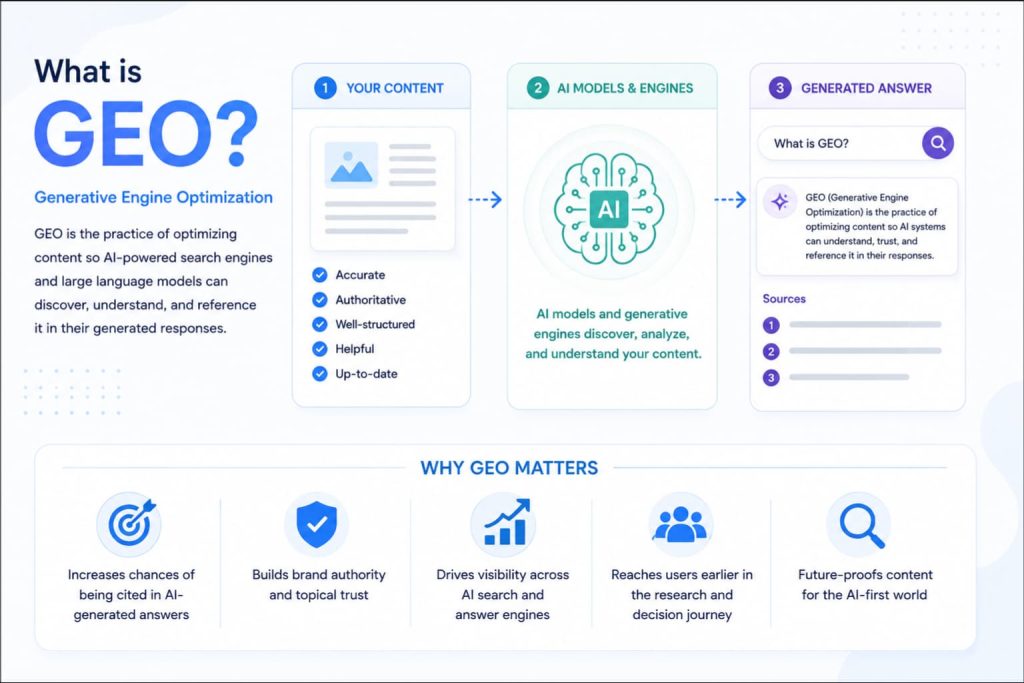
GEO is the practice of optimizing content so AI-powered search engines and large language models (LLMs) can discover, understand, and reference it in their responses. The goal isn't simply to rank higher in search results, it's to increase the likelihood that your content becomes part of the answer users receive.
As AI assistants become a common starting point for research and decision-making, content needs to be more than keyword-optimized. It must be accurate, trustworthy, well-structured, and comprehensive enough for AI systems to confidently use as a source.
Rather than replacing SEO, GEO builds on its foundation. While SEO focuses on helping users find your content, GEO focuses on helping AI systems understand and reference it.
For businesses looking to remain visible in an AI-first search environment, optimizing for both is becoming increasingly important.
How AI Search Engines Discover and Evaluate Content
AI-powered search engines evaluate content differently from traditional search engines. While keywords still matter, modern AI systems place greater emphasis on context, credibility, relevance, and user intent.
Rather than simply matching a query to a webpage, AI models analyze information from multiple sources to generate a comprehensive answer. To improve visibility in AI-powered search, brands should focus on the following factors:
1. Authority & Trust
AI systems are more likely to reference content from sources they consider credible and reliable.
Trust signals include:
- Expert authorship
- Industry recognition
- Accurate and factual content
- Citations from reputable sources
- Consistent brand presence across the web
The stronger your authority signals, the more likely AI systems are to treat your content as a trusted source.
2. Content Structure
Well-structured content is easier for AI systems to understand and extract information from.
Best practices include:
- Clear heading hierarchy (H1, H2, H3)
- Short paragraphs
- Bullet points and numbered lists
- Tables and comparison charts
- FAQ sections
Content that is easy for humans to scan is often easier for AI systems to interpret as well.
3. Topical Authority
AI search engines increasingly evaluate expertise at the topic level rather than the page level.
Instead of publishing isolated articles, focus on building comprehensive coverage around core subjects. Topic clusters, pillar pages, and supporting content help establish your brand as a subject-matter authority.
4. Context Over Keywords
Traditional SEO often emphasized exact-match keywords. AI systems are designed to understand meaning, relationships, and user intent.
Rather than optimizing for a single keyword, create content that thoroughly answers questions, addresses related concepts, and provides complete coverage of a topic.
5. Entity Recognition
AI models rely heavily on entities, people, brands, products, locations, and concepts, to understand information and relationships.
Clearly defining and consistently referencing relevant entities helps AI systems better understand your expertise and relevance within a topic area.
6. Freshness & Accuracy
For rapidly changing industries such as technology, finance, healthcare, and digital marketing, AI systems favor current and accurate information.
Regularly update content with:
- Recent statistics
- Industry developments
- New examples
- Updated recommendations
Maintaining content accuracy strengthens both user trust and AI confidence.
The Key Takeaway
Successful GEO strategies are built on the same qualities that create valuable content for users: expertise, trustworthiness, clarity, and relevance. The easier your content is to understand and trust, the more likely it is to be surfaced in AI-generated responses.
The Growing Importance of AEO and LLMO
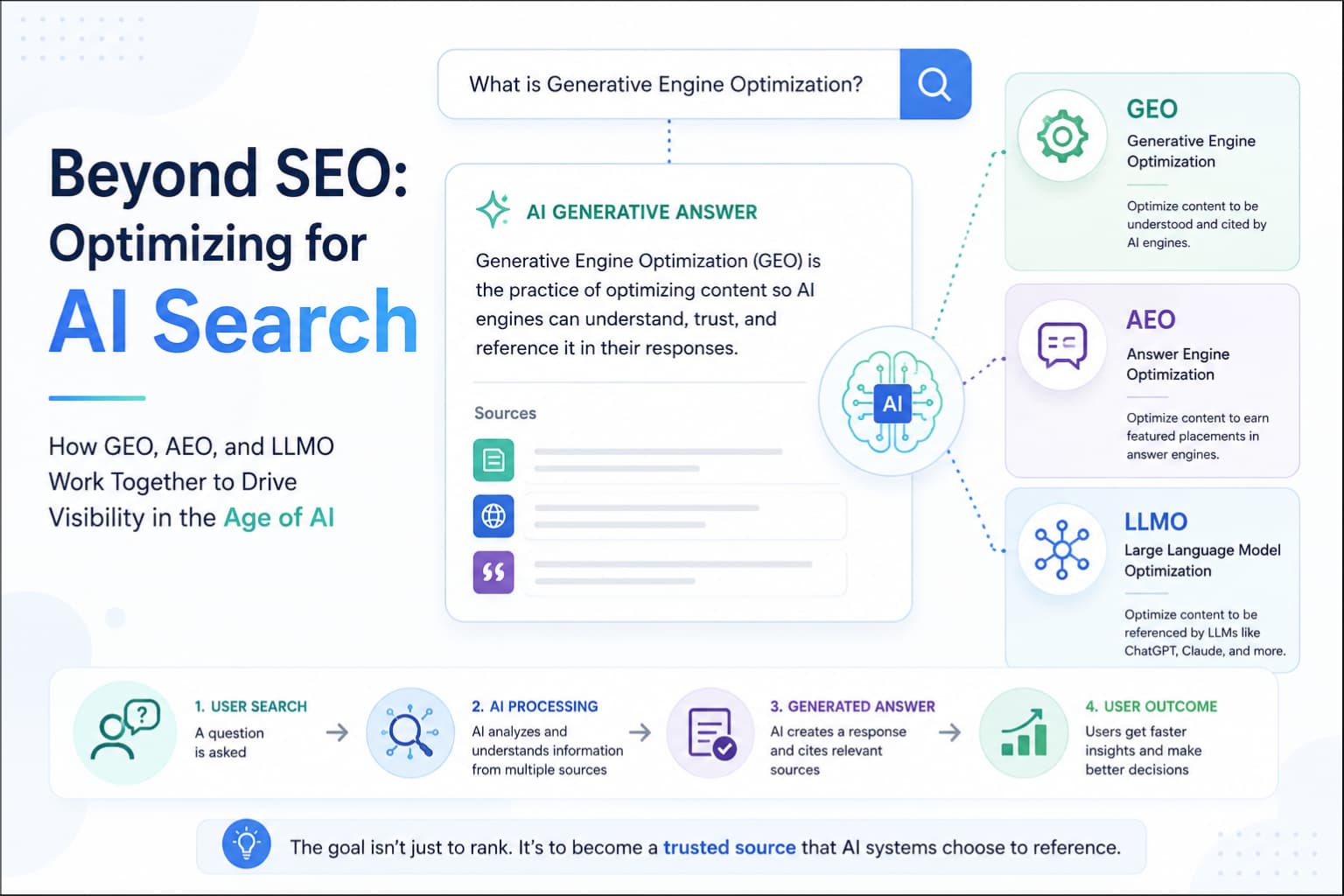
Generative Engine Optimization (GEO) is only one part of the evolving AI visibility landscape. As search becomes increasingly AI-driven, brands need to understand how GEO works alongside Answer Engine Optimization (AEO) and Large Language Model Optimization (LLMO).
Each discipline addresses a different aspect of digital visibility, and together they help brands remain discoverable across both traditional search engines and AI-powered platforms.
The Modern Search Optimization Framework
| Discipline | Primary Goal | Focus Area |
| SEO | Help users find your content | Search rankings and organic traffic |
| AEO | Help your content become the answer | Direct answers, snippets, and FAQs |
| GEO | Help AI systems cite your content | AI search visibility and references |
| LLMO | Help AI models understand and trust your brand | Authority, consistency, and knowledge representation |
AEO: Optimizing for Direct Answers
With more users turning to conversational search, search engines and AI assistants prioritize content that delivers clear, concise answers.
Common AEO tactics include:
- FAQ sections
- Question-based headings
- Featured snippet optimization
- Concise definitions and summaries
- Structured content formats
The goal is simple: make it easy for search engines and AI systems to extract and present your content as an answer.
LLMO: Optimizing for AI Understanding
LLMO extends beyond search visibility and focuses on how large language models perceive your brand, products, and expertise.
Key LLMO considerations include:
- Consistent brand messaging
- Strong topical authority
- Accurate and up-to-date information
- Mentions across trusted sources
- Clear entity relationships
The more consistently your brand appears across authoritative sources, the easier it becomes for AI models to understand and confidently reference it.
Why They Work Better Together
SEO, AEO, GEO, and LLMO are not separate strategies, they are complementary layers of a modern visibility framework.
SEO helps users discover your content. AEO helps your content become the answer. GEO helps AI systems reference your content. LLMO helps AI models understand and trust your brand.
Organizations that invest in all four areas will be better positioned to compete in an increasingly AI-driven search ecosystem.
Preparing Your Content Strategy for AI Search
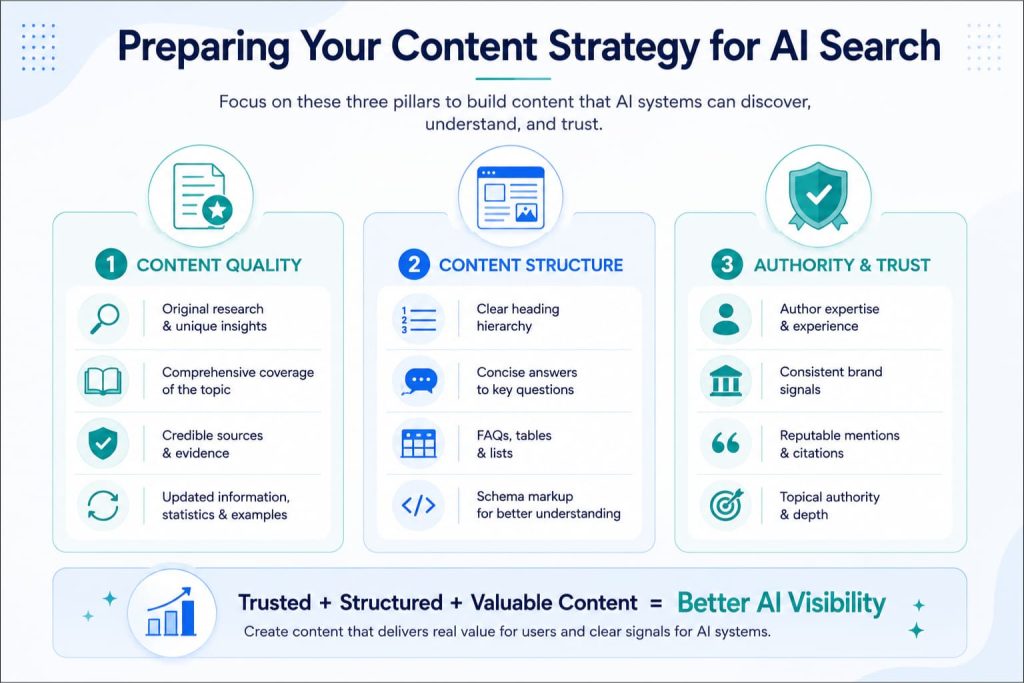
Optimizing for AI search doesn't require an entirely new content strategy. In many cases, it means strengthening the fundamentals that make content valuable, trustworthy, and easy to understand.
Use the framework below to assess whether your content is ready for AI-powered discovery.
Content Quality
Focus on creating content that demonstrates expertise and provides unique value.
✓ Publish original research, case studies, or expert insights
✓ Cover topics comprehensively rather than creating isolated articles
✓ Support claims with credible sources and evidence
✓ Keep statistics, examples, and recommendations up to date
Content Structure
Make it easy for both users and AI systems to navigate and understand your content.
✓ Use clear headings and logical content hierarchy
✓ Include concise answers to common questions
✓ Add FAQ sections where relevant
✓ Use tables, lists, and summaries to improve readability
✓ Implement relevant schema markup
Authority & Trust
Build signals that reinforce your credibility across the web.
✓ Showcase author expertise and credentials
✓ Maintain consistent brand information across platforms
✓ Earn mentions and citations from reputable sources
✓ Develop topical authority through related content clusters
✓ Focus on delivering genuine value rather than publishing content solely to rank
GEO Readiness Question
Before publishing a piece of content, ask yourself:
If an AI assistant were answering a question about this topic, would it view this content as accurate, trustworthy, and useful enough to reference?
The brands most likely to succeed in AI search are those that consistently demonstrate expertise, authority, and value, not just those that optimize for rankings.
The Bottom Line
Search is no longer limited to a page of blue links.
Today, users can ask a question and receive an AI-generated answer compiled from multiple sources. As AI assistants become a common starting point for research and decision-making, visibility depends on more than rankings.
The brands that succeed will be those that consistently publish accurate, authoritative, and useful content. Rankings still matter, but content must also be trustworthy, well-structured, and easy for AI systems to understand.
GEO, AEO, and LLMO help organizations improve visibility across search engines, answer engines, and AI-powered platforms. In the age of generative AI, the brands that earn trust won't just appear in search results, they'll become part of the answers people rely on.